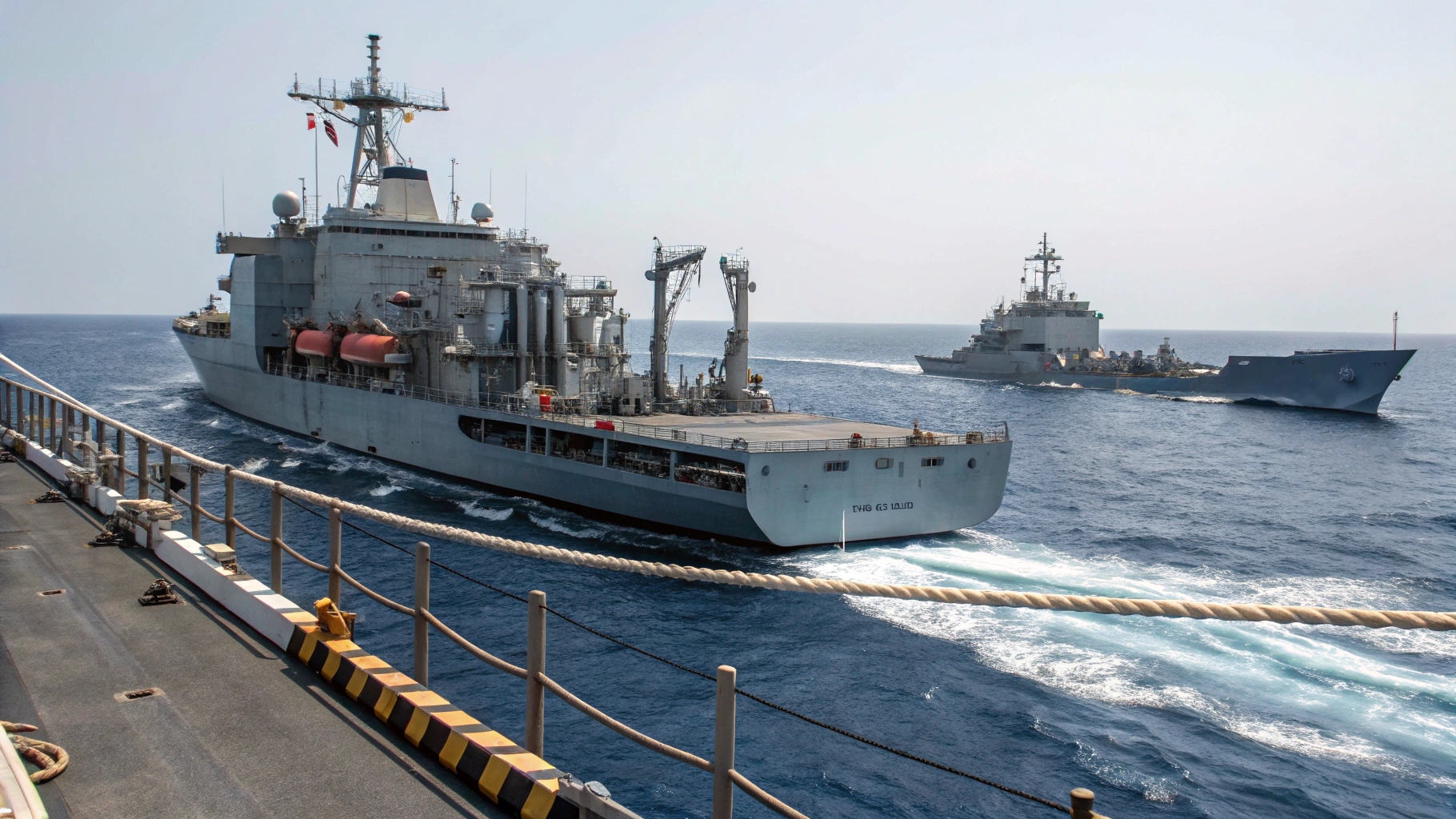

The US Navy has strengthened its underway replenishment fleet with a $1.7-billion contract awarded to General Dynamics NASSCO for the construction of two additional John Lewis-class fleet oilers, designated T-AO 215 and T-AO 216. The order expands the ongoing production line of next-generation logistics vessels designed to sustain naval operations at sea. Built at NASSCO’s San Diego shipyard, the oilers form part of a multi-ship acquisition strategy that may include up to eight more vessels of the same class. The company has already delivered four ships to date under an earlier $3.2-billion design-and-build contract initiated in 2016, marking steady progress in the Navy’s plan to recapitalize its replenishment capability. Each John Lewis-class oiler supports the Military Sealift Command and plays a critical role in sustaining deployed naval forces by transferring diesel, jet fuel, potable water, dry cargo, and other materials while ships remain underway. The replenishment process allows carrier strike groups and surface combatants to operate for extended periods without returning to port, directly supporting sea control, deterrence, and forward presence missions. Measuring 742 feet (226 meters) in length with a 106-foot (32-meter) beam and a full-load displacement of approximately 49,850 tons, each ship carries up to 162,000 barrels of fuel. The vessels are equipped with five replenishment stations, can reach speeds of around 20 knots (37 kilometers or 23 miles per hour), and are crewed by roughly 129 civilian mariners. NASSCO’s work on the class demonstrates the US Navy’s effort to maintain industrial capacity for auxiliary shipbuilding while ensuring that fleet logistics capabilities evolve alongside combatant platforms. The sustained investment supports domestic manufacturing, secures skilled labor at the San Diego yard, and provides a stable supply chain for materials, engines, and refueling systems. Through incremental procurement—adding ships through multiyear budget cycles—the Navy ensures cost control and production efficiency while aligning with its long-term objective to field a distributed, persistent, and refuel-capable global fleet. The contract underscores the strategic importance of naval logistics in maintaining operational reach and readiness across increasingly contested maritime domains.